Workplace Sexual Harassment and Assault
Sexual harassment and assault exist on a spectrum.
This spectrum names each level clearly so that people can navigate what is happening to them, and also understand what law may be applicable at the various levels.
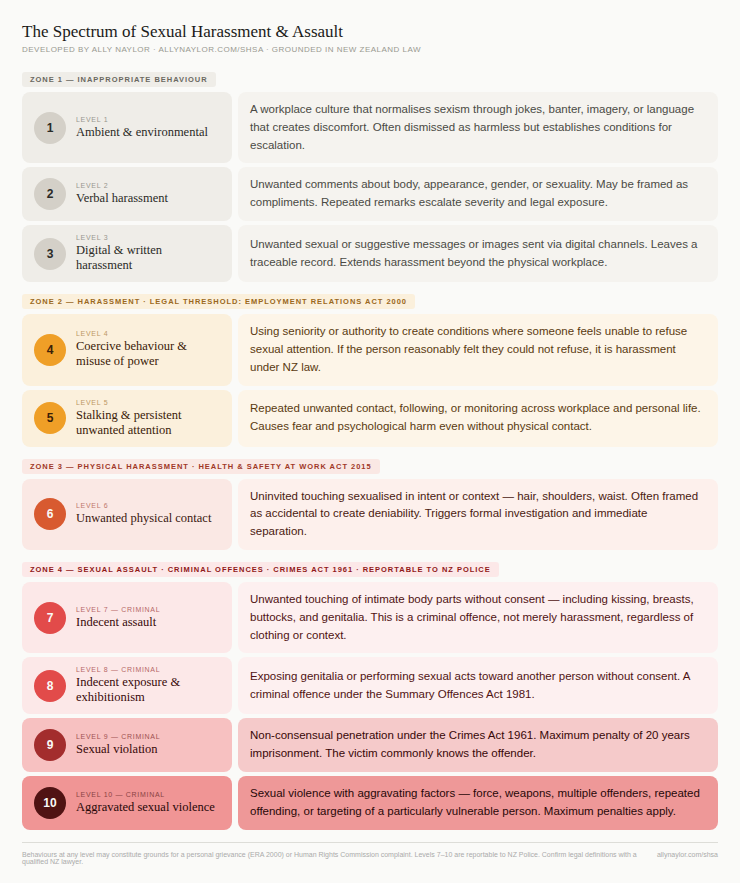
Legal note:
Behaviours at any level may constitute grounds for a personal grievance under the Employment Relations Act 2000 or a complaint to the Human Rights Commission. Levels 7–10 are also reportable to NZ Police. Escalation along the spectrum is common — early-stage behaviours frequently precede more serious harm.
When I went through my own experience, I had no roadmap.
No one told me what the law said, what my rights were, or what an organisation was actually obligated to do.
The pathway below is what I wish had existed — developed from that experience, grounded in New Zealand employment and criminal law, and designed to give both employees and employers the clarity they deserve.
Disclosure Response Pathway
A guide for HR professionals, managers, and board members — setting out how an organisation must respond when an employee discloses sexual harassment or assault, in passing or explicitly. Every disclosure requires a structured response.
Before any other step, show the employee the Harassment and Assault Spectrum and ask them to identify the behaviour(s) they have experienced. The level identified determines the urgency, pathway, and rights that apply.
- There is no pressure on the employee to categorise their experience precisely
- HR records what is shared without editorialising
- An employee may identify behaviours across multiple levels — record all of them
The position of the alleged person relative to the employee determines who leads the response and what escalation is required.
Peer / same level
Standard HR process applies. Line manager and HR lead involved. Standard investigation timeline.
Senior leader / direct manager
Escalate outside the direct reporting line. HR Director or independent contact leads. Line manager excluded from process.
Executive / CEO line
Board involvement required. CEO excluded from process entirely. External investigator appointed. Board Chair notified immediately.
Before any next steps are discussed or decisions made, the employee must be clearly informed of their rights. The employee does not need to decide anything immediately.
Rights that apply at every level
- Right to have a support person present at all meetings
- Right to confidentiality — disclosure will not be shared beyond those who need to know
- Right not to be disadvantaged in employment as a result of disclosing
- Right to choose whether to make a formal complaint or have the matter noted informally
- Right to withdraw or pause the process at any time
Levels 1–3: Inappropriate behaviour
- Personal grievance under the Employment Relations Act 2000
- Complaint to the Human Rights Commission
- Formal documentation even if no further action is taken
- Change in working arrangements if continued proximity causes distress
Levels 4–5: Harassment
- Separation from alleged person during investigation
- Independent investigator if alleged person is in reporting line
- Notification of investigation outcome to the extent legally possible
- Free employment legal advice — employer should facilitate
Level 6: Physical harassment
- Immediate physical separation — alleged person stood down
- Counselling support — employer to provide or fund referral
- Incident treated as health and safety matter under HASWA 2015
- Escalation to criminal complaint remains available at any time
Levels 7–10: Sexual assault Must state
- What has occurred is a criminal offence — state this explicitly Must state
- Right to report to NZ Police at any time — organisation cannot prevent this Must state
- Right to a Police sexual violence specialist
- ACC sensitive claim access — covers counselling regardless of Police complaint
- Access to specialist sexual violence support service — facilitate immediately
- Evidence must not be interfered with — employer must not pressure silence
- Alleged person must be stood down immediately Employer obligation
Where behaviour spans multiple levels, the highest level applies.
Levels 1–3: Internal management response
- Documented conversation with the alleged person
- Education or formal warning depending on severity
- Monitoring period established with clear expectations
- Employee kept informed of steps taken
- Outcome recorded in HR file
Levels 4–5: Formal HR investigation
- Written complaint recorded
- Independent investigation commenced
- Alleged person notified and separated if requested
- Personal grievance pathway explained
- Outcome communicated to employee
Level 6: Formal investigation and immediate separation
- Alleged person stood down same day — mandatory
- HR and legal counsel engaged immediately
- Counselling referral offered
- Incident recorded as health and safety matter
- Criminal pathway reminder given
Levels 7–10: Police referral and specialist support
- Employee informed this is a criminal offence — explicitly
- Alleged person stood down immediately — mandatory, no exceptions
- Specialist sexual violence support facilitated same day
- ACC sensitive claim pathway explained
- Board notified if executive or CEO-line involved
- External legal counsel and investigator engaged
Written record
A written record of the disclosure and all actions taken is maintained in a secure HR file.
Regular check-ins
The HR lead checks in with the employee at minimum fortnightly for 3 months following disclosure.
Outcome communication
The employee is informed of the outcome to the extent permitted by law and privacy obligations.
Policy review
If the disclosure indicates a systemic issue, the organisation's policies are reviewed within 30 days.
No retaliation monitoring
The employee's employment conditions are actively monitored to ensure no disadvantage has occurred as a result of disclosing.
Review & improve
Each disclosure is an opportunity to assess whether culture, onboarding, and training adequately address harassment prevention.